
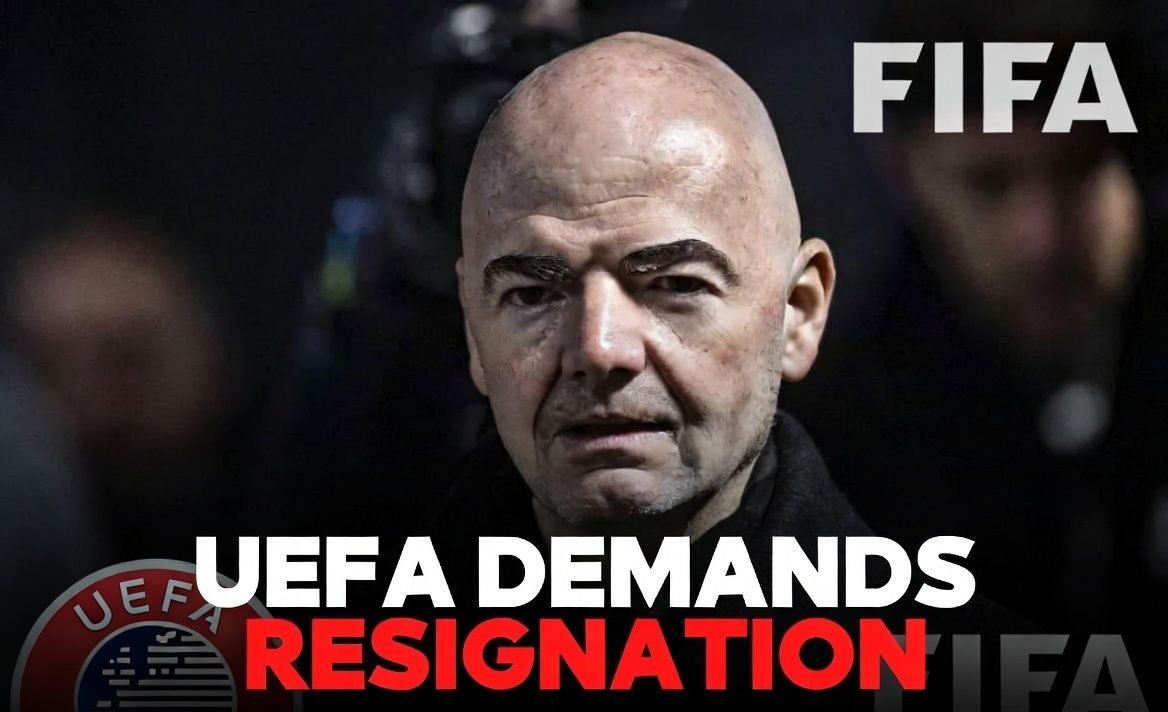
European football’s governing body has drawn a clear line in the sand.
According to exclusive reporting from The Telegraph, UEFA has told Gianni Infantino he must step down as FIFA President. If he refuses, the 55 European member associations are prepared to trigger a formal vote of no confidence and push for his removal.
This is not just angry talk after a bad week. This is the most serious challenge to Infantino’s leadership since he took the job in 2016.
What triggered the crisis?
Last week FIFA floated a plan to create a new commercial entity (often called the FIFA Forward Enterprise or similar) and sell roughly a 20% stake to private investors for around $4.2 billion. One of the investment groups linked to the deal was connected to Joshua Kushner, brother of Jared Kushner.
UEFA’s response was nuclear. On Thursday its 55 member associations voted unanimously to boycott all FIFA competitions — including the World Cup — unless the proposal was completely abandoned and binding guarantees were given that FIFA competitions would never again be opened to private ownership.
Other confederations piled on. CONCACAF and the Asian Football Confederation also opposed the plan. Suddenly Infantino faced opposition from associations representing well over 130 of FIFA’s 211 members.
Faced with that wall of resistance, and with his own senior adviser Carlos Cordeiro resigning in protest, Infantino abandoned the plan late on Friday night. He admitted the project had “created divisions.”
Most presidents would have hoped the climbdown would end the story. UEFA decided otherwise.
UEFA’s public statement
On Saturday UEFA released a blistering statement. It welcomed the withdrawal of the plan as “a victory for the whole game” but made clear the real problem went deeper.
Key lines included:
- “We cannot keep going on like this with secret schemes on fast track timescales, cooked up by faceless individuals and of dubious benefit to the game.”
- “The current FIFA leadership has not only lost UEFA’s confidence but also that of many other members of the football family.”
- “No option should be off the table.”
They also reminded Infantino of his own 2016 election promises about transparency and using FIFA’s money only for the development of football. “On both these promises, he has failed to deliver,” UEFA said. The proposed deal was described as a “shabby, back room, opaque” arrangement.
The vote of no confidence threat
While UEFA’s public language stopped short of an explicit public demand for resignation, The Telegraph reported that the message delivered privately was far more direct: resign or face a no-confidence vote.
Under FIFA’s statutes (Article 25), just one-fifth of the 211 member associations — 43 countries — can force an extraordinary Congress. UEFA alone has 55 members. They can trigger the process easily.
Once an extraordinary Congress is called, a simple majority of valid votes (more than 50%, roughly 106 associations) is enough to remove the president. With UEFA, AFC and CONCACAF already aligned against the now-scrapped commercial plan, the numbers look extremely dangerous for Infantino.
His current term runs until March 2027, when he is due to stand for what would be a fourth term. That election suddenly looks far less certain than it did a week ago.
Why this feels different
Infantino has survived previous storms. This one carries a different weight. The combination of a near-unanimous European boycott threat, internal FIFA resignations, open criticism from multiple confederations, and now a concrete mechanism for his removal has created the most serious threat to his presidency yet.
There is also growing talk of potential alternative candidates. Names that have surfaced in recent days include Nasser Al-Khelaifi (Paris Saint-Germain president and UEFA Executive Committee member) and CONCACAF president Victor Montagliani.
Whether Infantino chooses to fight or step aside in the coming days will shape the immediate future of world football governance.
What’s next?
UEFA has said it will work with its associations and other confederations in the coming days and weeks to review how the commercial proposal even reached this stage and to put safeguards in place so it cannot happen again. The phrase “no option should be off the table” is being widely interpreted as keeping the door open to forcing a change at the top of FIFA.
Infantino has not yet publicly responded to the specific resignation demand.
Football rarely moves this fast at the political level. For once, the sport’s European power base has shown it is willing to use every tool available. The next few days will tell us whether Gianni Infantino’s long grip on FIFA is finally loosening.