
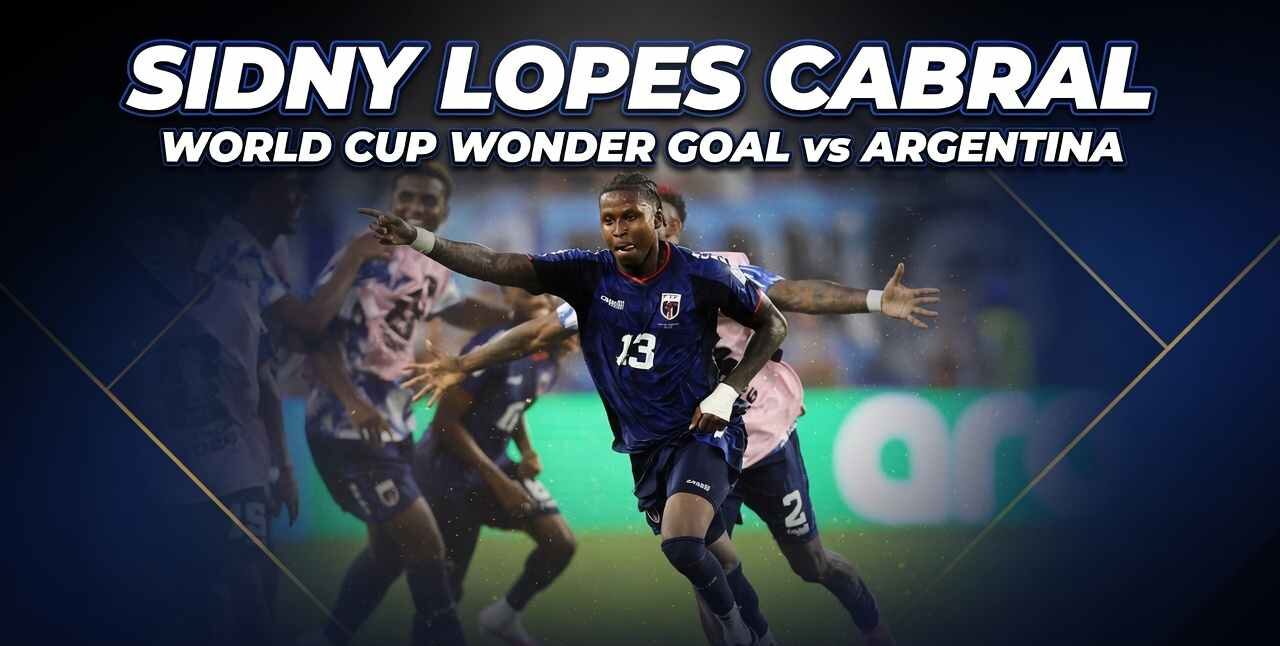
In the 103rd minute of extra time on a humid Miami night, Sidny Lopes Cabral produced one of the goals of the 2026 FIFA World Cup. The Cape Verde full-back picked up the ball, drove forward with purpose, and curled a stunning strike into the far corner to make it 2-2 against defending champions Argentina.
Teammates swarmed him in celebration as the small but passionate Cape Verde contingent erupted. Though Argentina eventually won 3-2, Lopes Cabral’s golazo — instantly dubbed one of the tournament’s best — wrote a new chapter in one of football’s most remarkable stories of the last 18 months.
Just 18 months earlier, the 23-year-old was playing in Germany’s third tier.
Born in Rotterdam but representing Cape Verde, Lopes Cabral spent the 2024/25 season at Viktoria Köln in the 3. Liga. Solid but far from the spotlight. Then came the summer of 2025 and a move to Portuguese Primeira Liga side CF Estrela da Amadora.
He didn’t just adapt — he exploded. Operating as a modern, attacking wing-back (two-footed and comfortable at left-back, left wing-back, right-back, or even further forward on either flank), he scored five goals and added key assists in a short spell. His performances turned heads across Europe.
By late December 2025, Benfica had seen enough. They paid around €6 million (potentially rising to €8.5m with add-ons) to sign him on a long-term deal until 2030. He made his debut off the bench in early January and, on 25 January, scored his first goal for the club in a 4-0 league win over — you guessed it — his former side Estrela da Amadora. It was the perfect statement.

Then came the controversy.
During Benfica’s Champions League tie against Real Madrid in February 2026, tensions were already high after Vinícius Júnior accused teammate Gianluca Prestianni of racial abuse in the first leg. After the second leg at the Bernabéu, images emerged of Lopes Cabral asking Vini Jr for his shirt.
The reaction from sections of the Benfica fanbase and some inside the club was fierce. He later apologised to his teammates, acknowledging it could have caused internal problems. The incident contributed to him being gradually phased out of the first-team picture.
Before the World Cup even began, he was on the move again.
In early summer 2026, Trabzonspor paid around €7 million to take him to the Turkish Süper Lig. A fresh start, a new challenge — and then came the call-up for Cape Verde’s historic World Cup campaign.
On 3 July 2026, in the Round of 32, he delivered the moment that will define his career so far. That curling extra-time equaliser against Argentina wasn’t just a goal — it was a statement of everything he had overcome in such a short space of time.
What makes Lopes Cabral special is his versatility and profile.
At 1.76m (5ft 9in), he’s not the biggest, but he’s explosive, technically clean on both feet, and dangerous in the final third. He can play multiple roles across the flanks, bomb forward, cross, shoot, and defend. Clubs love that kind of modern full-back/wing-back hybrid.
His journey — lower-league Germany → breakout in Portugal → Benfica → controversy → Turkey → World Cup wonder goal — is the kind of story that reminds us why we love football. Eighteen months ago, few outside Germany’s third division knew his name. Today, the whole world is talking about Sidny Lopes Cabral.
Cape Verde may have exited the tournament, but their star full-back has announced himself on the biggest stage. The next chapter of this extraordinary story is just beginning.